Research
Our group develops dynamical models of biological intelligence: how organisms, and groups of them, decide, remember and search, and what mechanisms make that possible. The work links stochastic neural dynamics, Bayesian inference, and adaptive decision making.
SOCIAL DECISION MAKING
Social decision making
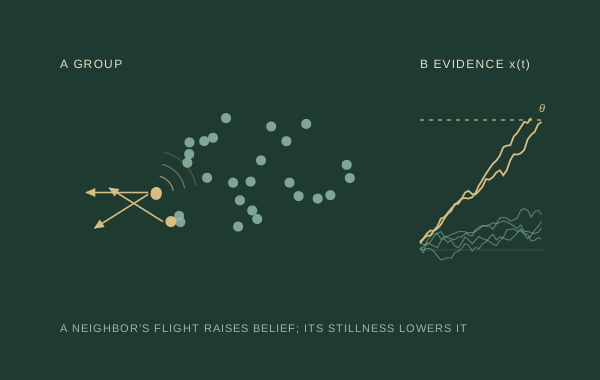
A group faces the same speed–accuracy tradeoff as an individual, but its members can watch one another. A neighbor’s flight is evidence of danger and its stillness is evidence of safety, and a single rate at which animals discount a threat when others stay still lets a group be both faster and more accurate than a lone individual.
Social information is worth something in other settings too, since others have sampled the patch, but coupling that is too strong drags a forager out of a patch it should have stayed in. Recruitment, inhibition, and individual differences all set where a collective lands between those failures.
- Social discounting enables fast and reliable collective escapeZ.P. Kilpatrick · Preprint, 2026
- Daring few, patient many: division of labor in decentralized foraging collectivesH. Kim, Z.P. Kilpatrick & K. Josić · PNAS, 2026
- Stochastic dynamics of social patch foraging decisionsS. Bidari, A. El Hady, J.D. Davidson & Z.P. Kilpatrick · Phys. Rev. Research, 2022
- Heterogeneity improves speed and accuracy in social networksB. Karamched, M. Stickler, W. Ott, B. Lindner, Z.P. Kilpatrick & K. Josić · Phys. Rev. Lett., 2020
- Bayesian evidence accumulation on social networksB. Karamched, S. Stolarczyk, Z.P. Kilpatrick & K. Josić · SIAM J. Appl. Dyn. Syst., 2020
- Social inhibition maintains adaptivity and consensus of foraging honey bees in dynamic environmentsS. Bidari, O. Peleg & Z.P. Kilpatrick · R. Soc. Open Sci., 2019
DECISION MAKING
Decision making and Bayesian inference
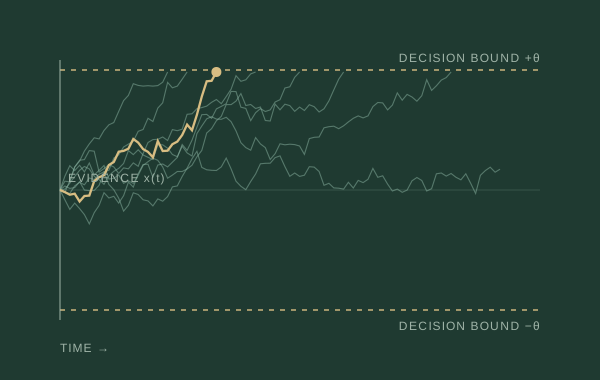
When the world changes, old information can become misleading. I study how decision makers balance incoming evidence, prior experience, and the possibility of change.
Questions include when to stop gathering evidence, how to learn environmental change rates, and when seeking information is more valuable than chasing a reward, and when to abandon a depleting patch.
- Human decision-makers terminate evidence accumulation using flexible decision rulesI. Kalburge, A. Dallstream, K. Josić, Z.P. Kilpatrick, L. Ding & J.I. Gold · eLife, 2026
- Information-seeking decision strategies mitigate risk in dynamic, uncertain environmentsN.W. Barendregt, J.I. Gold, K. Josić & Z.P. Kilpatrick · J. R. Soc. Interface, 2026
- Normative decision rules in changing environmentsN.W. Barendregt, J.I. Gold, K. Josić & Z.P. Kilpatrick · eLife, 2022
- Optimizing sequential decisions in the drift-diffusion modelK.P. Nguyen, K. Josić & Z.P. Kilpatrick · J. Math. Psychol., 2019
- Stochastic models of evidence accumulation in changing environmentsA. Veliz-Cuba, Z.P. Kilpatrick & K. Josić · SIAM Review, 2016
- Uncertainty drives deviations in normative foraging decision strategiesZ.P. Kilpatrick, J.D. Davidson & A. El Hady · J. R. Soc. Interface, 2021
NEURAL DYNAMICS
Neural dynamics and working memory
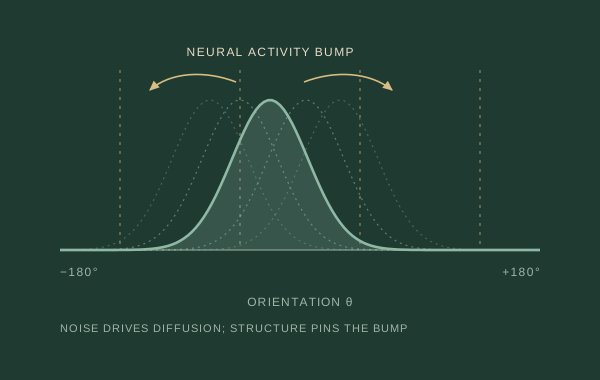
Neural activity can persist after a stimulus disappears. I study how these patterns encode information, wander under noise, and interact with the structure of a network.
Working-memory errors offer a window into these dynamics, and into the way experience shapes our expectations.
- Wandering bumps in stochastic neural fieldsZ.P. Kilpatrick & B. Ermentrout · SIAM J. Appl. Dyn. Syst., 2013
- Astrocytic resource diffusion stabilizes persistent activity in neural fieldsN. Palmer, H.L. Cihak, D. Avitabile & Z.P. Kilpatrick · SIAM J. Life Sci., 2026
- Multiscale motion and deformation of bumps in stochastic neural fields with dynamic connectivityH.L. Cihak & Z.P. Kilpatrick · Multiscale Model. Simul., 2024
- Learning efficient representations of environmental priors in working memoryT.L. Eissa & Z.P. Kilpatrick · PLoS Comput. Biol., 2023
- Synaptic mechanisms of interference in working memoryZ.P. Kilpatrick · Sci. Rep., 2018